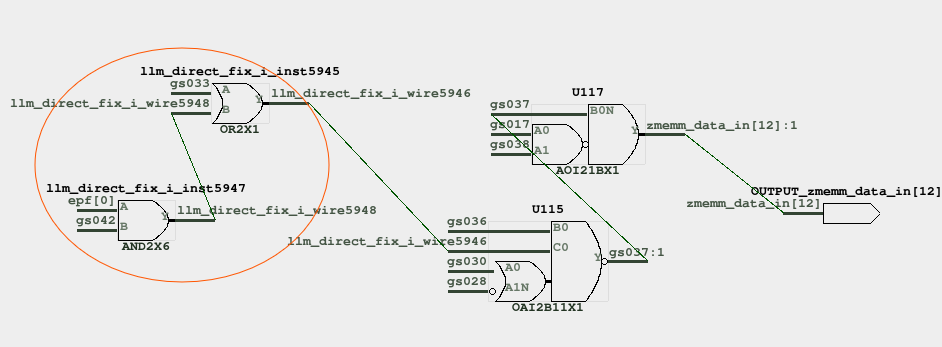
For years, the "surgical" functional ECO was considered a uniquely human art form. Conventional automation was seen as too crude, often resulting in excessive logic overhead. This assumption is now obsolete. AI agents have proven they can perform "manual-style" ECOs with the same or better finesse as an experienced engineer. By leveraging the reasoning power of LLMs to "read" netlist schematic data through JSON, AI can autonomously trace logic cones and implement patches that are leaner and more accurate than those created by hand.

The Challenge: A Precise RTL Logic Change
Consider a late-stage requirement change in a display controller module. In a specific operational mode, an internal signal must transition from driving a constant high value to tracking a dynamic data input.
always @(*)
    if (dbi_565)
        case (epf)
            2'b01: begin
                if (disp_data[17:13] == 5'h1f)
                    r0 = 1'b1; // ORIGINAL
                    r0 = disp_data[1]; // ECO FIX
                else
                    r0 = 1'b0;
	    end
	...
    assign zmemm_data_in = (dbi_565 ? {disp_data[17:13], r0, disp_data[11:1], b0} : disp_data);
A manual engineer must locate the exact gates implementing the condition (dbi_565 & epf==01 & disp_data==5'h1f) and hijack the driver of r0 to inject disp_data[1]—all without disturbing neighboring logic.
The AI Investigator: Logic Cone Navigation
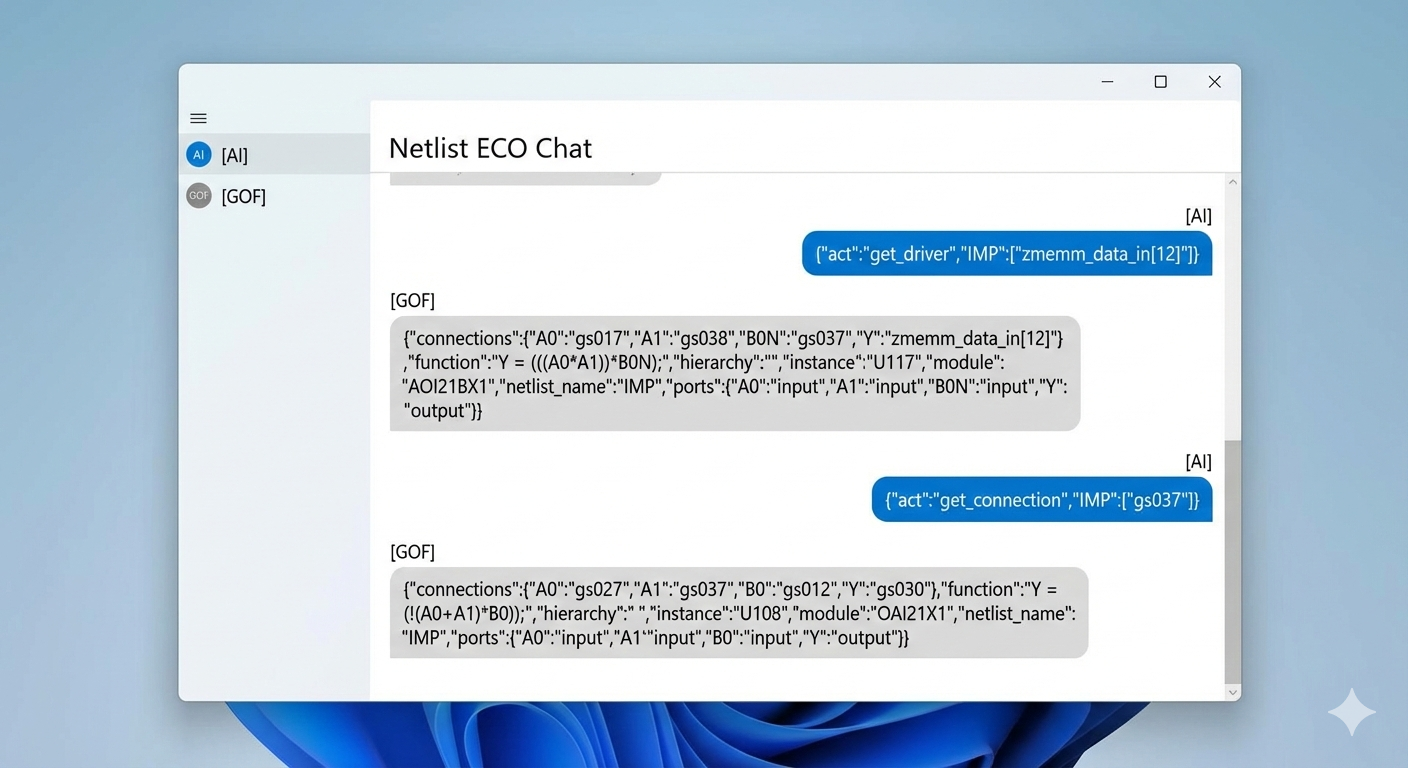
Instead of manual schematic probing, the AI acts as a reasoning agent. It issues queries to the GOF schematic engine and interprets the netlist topology through JSON responses, performing a methodical backward trace of the logic cone.
Step 1: Identifying the Target Driver
The AI identifies that the RTL signal r0 fanouts to the output port signal zmemm_data_in[12]. Querying the driver, GOF reveals it is driven by an AOI21BX1 complex gate (Instance U117).
Step 2: Recursive Backward Tracing
The AI analyzes the boolean function of U117 and requests the drivers for its specific input pins. By iteratively mapping these physical gates back to the original RTL intent, the AI pinpointed the critical control signals:
- Determined that input B0N (net
gs037) was the primary control path.
- Analyzed
U115 (driving gs037) and identified that net gs033 drops LOW specifically when the ECO condition is met.
- Confirmed this was the optimal insertion point for the
disp_data[1] muxing logic.
The "Surgical" Result
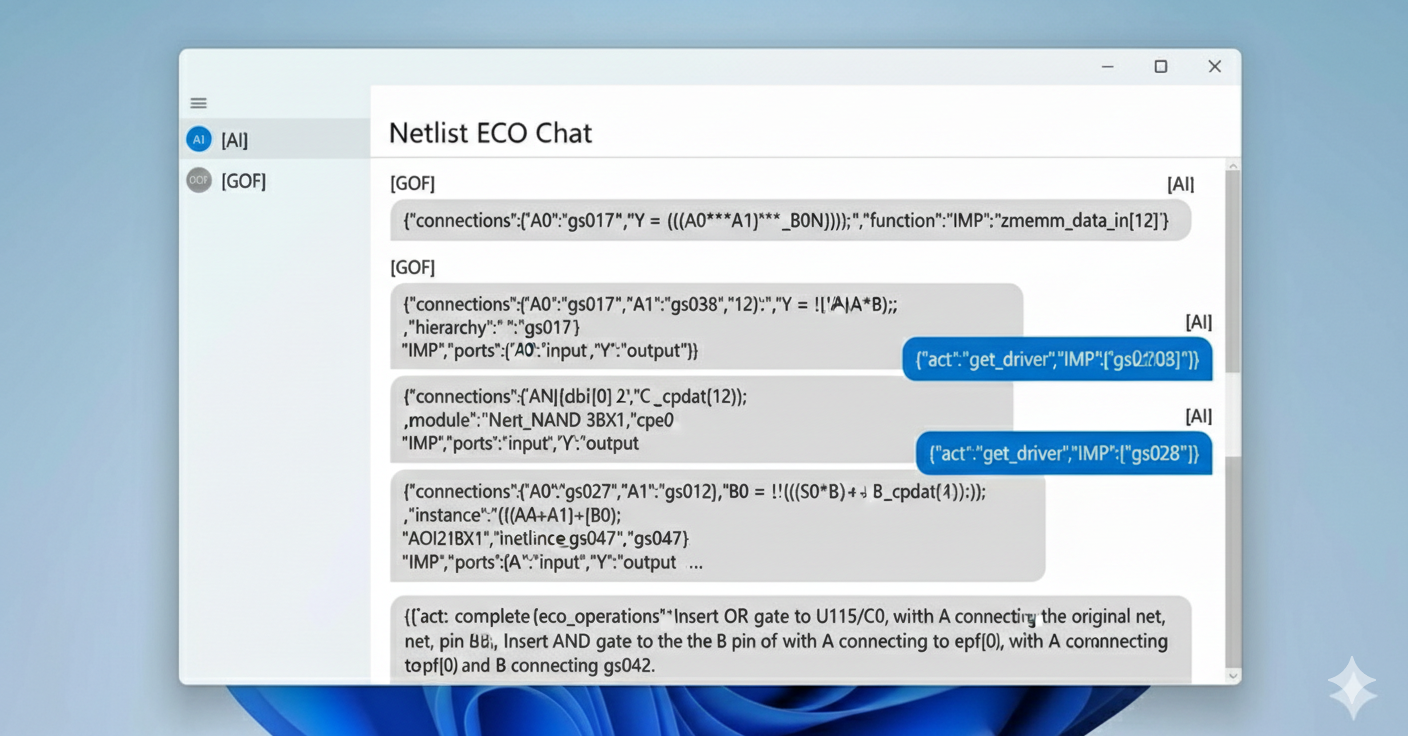
The AI agent doesn't just suggest a fix; it constructs a precise ECO operation sequence. GOF takes the plain English ECO operation sequence, and converts them into internal netlist ECO APIs to do the surgery.
Final ECO Operation Sequence
[CMD 1]
Insert OR gate
to U115/C0,
with pin A connecting the original net, pin B floating.
[CMD 2]
Insert AND gate
to the B pin
of previous OR gate, with pin A connecting to epf[0]
and pin B connecting to gs042.
The resulting patch was analyzed and found to be 30% smaller than the output generated by standard automated ECO algorithms, proving that AI-driven reasoning can master the "human" art of the surgical fix.